
Co founders Devadhara Healing & The Creator's Child Spiritual initiative.
The other day, Kapil Kansal, creative director, met a model wearing Diesel Jeans. Why was the model wearing Diesel jeans? he queried.
Because Diesel was a great brand. And what made it a great brand? Kapil asked.
“Because Arjun Rampal wears it,” the model replied.
“And would the model change brands if Arjun Rampal changed brands?”
“Of course”, was his reply, “He is a successful model, I wear what he does”.
The model's answer is revealing not just for what he said, but in his utter refusal to dissemble. Yes, he was buying into a successful lifestyle, he couldn't even conceive of why anyone could cringe at such a logic.
To some the implications are disturbing. For far from Diesel being the tag of a jeans, the jeans are the tags of Diesel's successful lifestyle. The gloss has become substance.
In the recent Wrangler jeans ad, even dirt and tattering has become – artificial, with blasé openness. Instead of being ashamed to walk around in the chicanery of the Wrangler stance, artificiality becomes a badge of honour. Of course, I am not holding up my tattered college jeans as a symbol of greater truth. For my mimicking of a cowboy ethic in urban India , especially in Stephen's, a college whose value had dwindled solely to the potence of its image, is equally laughable. The trend we've been a part of has gone further, in its logical direction.
The other day, I was looking at the Kellogg's pack and sharpening my creative director's eye by spotting all the design flaws, with great glee. My nephew's asked “What difference does it make, you don't eat the pack?”
True, the alignment problems were so minor to be invisible to the consumer's eye, yet the second half of the statement was not quite true. We do eat packs.
For example, in the coffee category, that I have done advertising extensively for, the colour of the pack changes the taste perception of coffee.
In a perceptual experiment, an identical variety of coffee was packed in black, gold, red, blue, and brown packs. Even though the coffee was identical, consumer's perception of the coffee from the different packs were radically different. Coffee packed in gold and black packs tasted more premium. The taste of coffee from the red pack was perceived as rich and strong. The taste of coffee from the brown pack had strength. Coffee from the blue pack was mild.
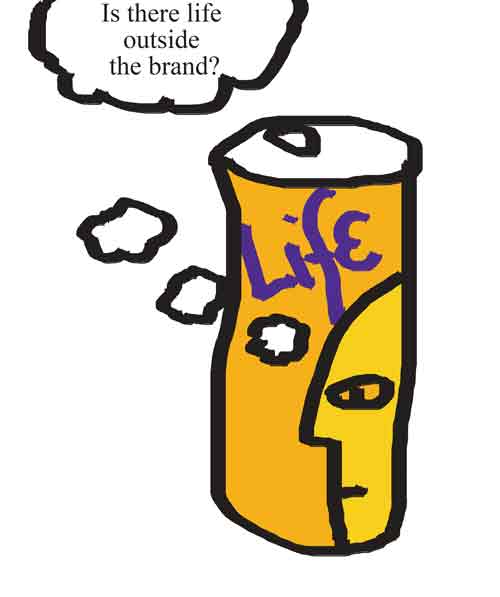
The fact is we eat packaging and consume brands.
“But brands are essential” a colleague argued, “without brands life would grind to a halt…remember as in that blank pack commercial” , he argued. When I pointed out the all too obvious fact that mankind and civilisation has survived millennia without brands, he did a double take. It was true. Why had the obvious become invisible?
In Anand Patwardhan's film “War and Peace” there's a scene where a shopkeeper in Pokhran pooh poohs the claim that the nuclear testing at Pokhran could cause cancer deaths in the surrounding areas. The unsaid meta-message was that even if there were, it was a small price to pay. But what was the gain that was so great that cancer was a minor price? To quote from memory ‘The bomb has made Pokhran famous, after all, what is more important than name and reputation?' Gloss causes cancer.
In many parts of the world, social service advertising tries to stop people from getting caught in the glamour of smoking. The stick used to drive people away is often the statistical link between smoking and cancer. This quixotically becomes the nub of a guerrilla marketing thrust. An American cult cigarette proudly calls itself Death. It has a small but strong market and represents the significant minority market in all fields, here the negative is treasured, a sort of sado-masochistic honesty and black humour. An implicit message is, yes cigarettes cause cancer in a few. So? With Death, I smoke the black heart of that which is deployed to try and convince me to stop.
A few weeks ago, I received an e-essay authored by Abdul Kalam. It's about the need for India to develop. What is scary is the picture of development he offers is so one-dimensional. Development was solely equated with outward measures of success, it's a replay of the American dream as bandied in the 50s. It's good to remember that the shallow and brilliant dream was the same that powered the dangerous nuclear posturing of that era. ‘Be careful for what you ask, you may get it', says the old adage.
Commenting on this issue Saeed Mirza got quite gussa, “If you have a dream for India it has to be gloss & chrome it has to have our perception of liberalisation”.
Today, in advanced economies, does the economy serve the human, or does the human serve the economy? Today, all values are dictated by how economically relevant it is. Companies like BMW have detailed brand guidelines that dictate even what words employees may use in communication. Your desires too are not yours, they are mass-produced. For what you buy is not necessarily what you want but what your neighbours expect of you. And what do your neighbours expect of you? What the economy wants. As Dr Yash commented “People don't get what they like. They like what they get”.
Now, the system even rides rebellion. The Sprite “baki sab bakwas” ads do precisely this. For even one's disgust with economic manipulation becomes just fuel for the brand.
The gloss doesn't stop there, for it demands that one be a certain kind of person, with a regulation body. Too harsh you say?
In an interview Anil Ambani, king of one of the most powerful corporate empires revealed the reason he shed weight a few years ago. No, not because it was good for his health. But because a financier abroad told him that his paunch didn't inspire shareholder confidence, galvanised by this he lost weight. His body became fodder for economic ambition. His wealth doesn't serve him, he serves his wealth.
There are in the papers glowing reports of a strange, pink, featherless example of genetic butchery. This chicken, so awfully violated, is being held out as an example of scientific brilliance. Are we so comfortably numb that we hold this sorry Frankenstein designed only to maximise meat for the table, as the epitome of human brilliance? What's practised on animals today is usually then the future of mankind tomorrow. Welcome to your new look.
The gloss however demands more than our minds and bodies, it also demands the sacrifice of peace. Ramesh Jude Thomas, a brand consultant, argues that economic change has been usually catalysed by war or deep catastrophe. And that what India needs is war. So to get the gloss one needs to give blood – a fair exchange some would say.
Which of course leaves one with the world. But even that's about to be glossed over. Bart Kosko, a fuzzy logician, argues that since the relationship between maths and reality is so strong instead of bothering with reality one could just study computer simulations.
“ If you see the real you may loose your sanity”, says Saeed Mirza. Yet some say that's fine, if at the end of the process we find the golden pot. Maybe. But it won't necessarily bring us happiness.
In a study that compared happiness levels in different countries, the survey showed that India and the so-called more developed USA were on par when it comes to levels of happiness. Surprise! Surprise! Money doesn't bring us happiness.
We have exchanged the old lamps of the real for the new lamp of gloss. And in fact we may have lost in the process. Redeeming it calls for redeeming ourselves. But before we do that we must realise that we are losers in the deal.
In a Chinese fable, a Chinese emperor had a nightingale at his court, it sang beautifully. Then one day a man brought a mechanical nightingale to court. What a marvel! Everyone feted the mechanical nightingale. But after a while its limitations were exposed. It could play but a few tunes. And being mechanical it broke down. Then the court realised what fools they had been and went searching for the real nightingale. But it had left the court. After a deep search they found it. And brought its magic back.
In the modern context, one has a less savoury ending to choose from. The mechanical nightingale played well, some notes it played however couldn't be heard by human ears. So, perhaps they could modify it, the human's ears we mean. Then they discovered that to be compatible with the ears, so one had to reengineer the heart and brain with mechanical ears. So, one had a mechanical court listening to mechanical nightingale. Did they live happily ever after? Maybe we will find out first hand.
This is a dark essay, with the shadows exaggerated and our civilisation caricatured. But perhaps like a cartoon it reveals the true character of our age better. And if we don't like it we can change, perhaps not just from Diesel to Wrangler, or Pepsi to Sprite.
Tarun & Celia Cherian, Are Spiritual Guides. Aura Masters. And Founders of Devadhara Healing. They help sufferers fight the incurable, the lost find clarity and seekers touch the ultimate, through their spiritual initiative – Creators Child.